
Hand Tools
Early Settler Hand Tools in Canada
A close look at the broad axes, drawknives, froes, and augers that equipped the first wave of settlers in Upper and Lower Canada — and what each tool reveals about the conditions of frontier life.
Canadian Heritage Trades Archive
From the broad axe that hewed the first timber frame to the bellows that kept a frontier smithy alive through a January night — this archive documents the material culture of pre-industrial Canada.
Read the Archive About This ResourceFeatured Articles
Hand Tools
A close look at the broad axes, drawknives, froes, and augers that equipped the first wave of settlers in Upper and Lower Canada — and what each tool reveals about the conditions of frontier life.
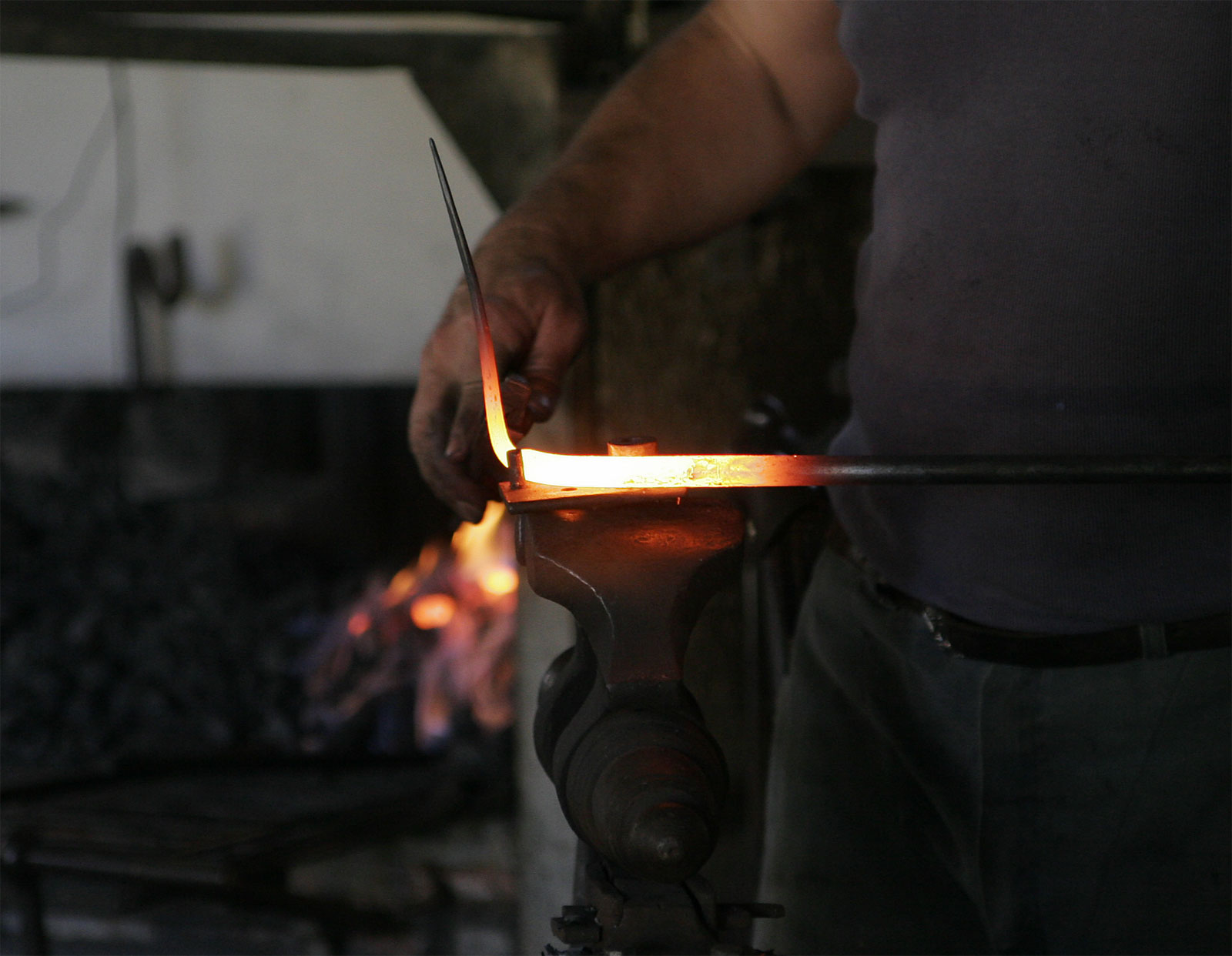
Blacksmithing
Iron was the currency of survival on the Canadian frontier. This article traces the history of the village blacksmith from the loyalist settlements of the 1780s through to mechanization in the late 19th century.

Craft Trades
Coopers, tanners, wheelwrights, and millwrights — this article maps the specialist trades that formed the economic backbone of Upper Canada before mechanized industry arrived.
Before hardware stores and mail-order catalogues, the blacksmith's forge was the closest thing most settlements had to a manufacturing hub. Ploughshares, wagon rims, hinges, and hooks — everything iron passed through the same fire. Understanding the forge is understanding how early Canadian communities held together through material scarcity.
Read the Blacksmithing ArticleTool Reference
Each of the following instruments had a specific role in the pre-industrial workshop — and a specific story in the Canadian context.

The primary timber-hewing tool of early Canada. Its wide, single-bevelled blade allowed a skilled hewer to produce a flat-faced beam from a round log in a single pass. Different regional patterns — the Québec pattern, the Pennsylvania pattern — spread north with settler populations.

Two handles, one blade, pulled toward the body. The drawknife was a shaving tool used by wheelwrights, chair-makers, and coopers to reduce and shape green wood quickly. Its portability made it indispensable on the frontier where a fixed workshop was rarely available.

Splitting wood along the grain rather than across it — that is the froe's purpose. Shingles, barrel staves, and chair legs were cleaved from billets of wood using this L-shaped blade and a wooden club. The result was stronger than sawn timber because the grain remained uncut.
Historical Context
Industrialization did not arrive uniformly across Canada. The first steam-powered sawmill appeared in New Brunswick in the 1820s, but many parts of northern Ontario and Québec continued to rely on hand-tool craft well into the 1870s. Rural blacksmiths operated into the 1920s in communities beyond the railway network.
This archive uses "pre-industrial" to describe the period and the practices — not a single date. The transition was gradual, regional, and shaped by transportation as much as by technology.
About This Archive
If you have photographs, diaries, estate records, or field observations related to Canadian heritage trades, the archive accepts documented submissions for editorial review.
For research questions, corrections, or archive contributions — fill out the form below.
Email: contact@flintparlor.org
Phone: +1 (613) 742-9180
Address:
284 Richmond Road
Ottawa, ON K1Z 6X4
Canada
Operating hours: Monday to Friday, 9:00 AM – 5:00 PM Eastern Time. Response time is typically 2–3 business days.
Material referenced in this archive draws on archival holdings at Library and Archives Canada, the Canadian Museum of History, and published academic work in material culture studies.
Browse Articles