Iron on the Frontier
Iron was not produced in significant quantities in colonial Canada. Every piece of wrought iron and steel that entered a frontier smithy had been imported — from Britain, from the American states, sometimes from France via Québec. This supply reality shaped everything about how Canadian blacksmiths worked: iron was treated carefully, scraps were hoarded, worn tools were re-forged rather than discarded. A frontier smithy in the early 19th century was partly a forge and partly a recycling operation.
The iron most commonly available in Upper Canada during the settlement period came in the form of bar stock — flat or square bars of wrought iron that the smith would cut, heat, and work into finished forms. Steel — specifically blister steel, made by the cementation process — was available but expensive. It was reserved for cutting edges: the bit of an axe, the blade of a drawknife, the point of a drill. The body of most tools was wrought iron; only the working face was steel-welded onto it.
The Village Smithy: Scale and Function
Historical records from the early 19th century suggest that a blacksmith was typically among the first four or five specialist tradesmen to establish in a new settlement, alongside a millwright, a carpenter, and a tavern keeper. The reason was practical: without a smith, the community could not maintain its agricultural equipment through a single season. A broken plough coulter or a cracked wagon tire could not wait for parts from a distant city.

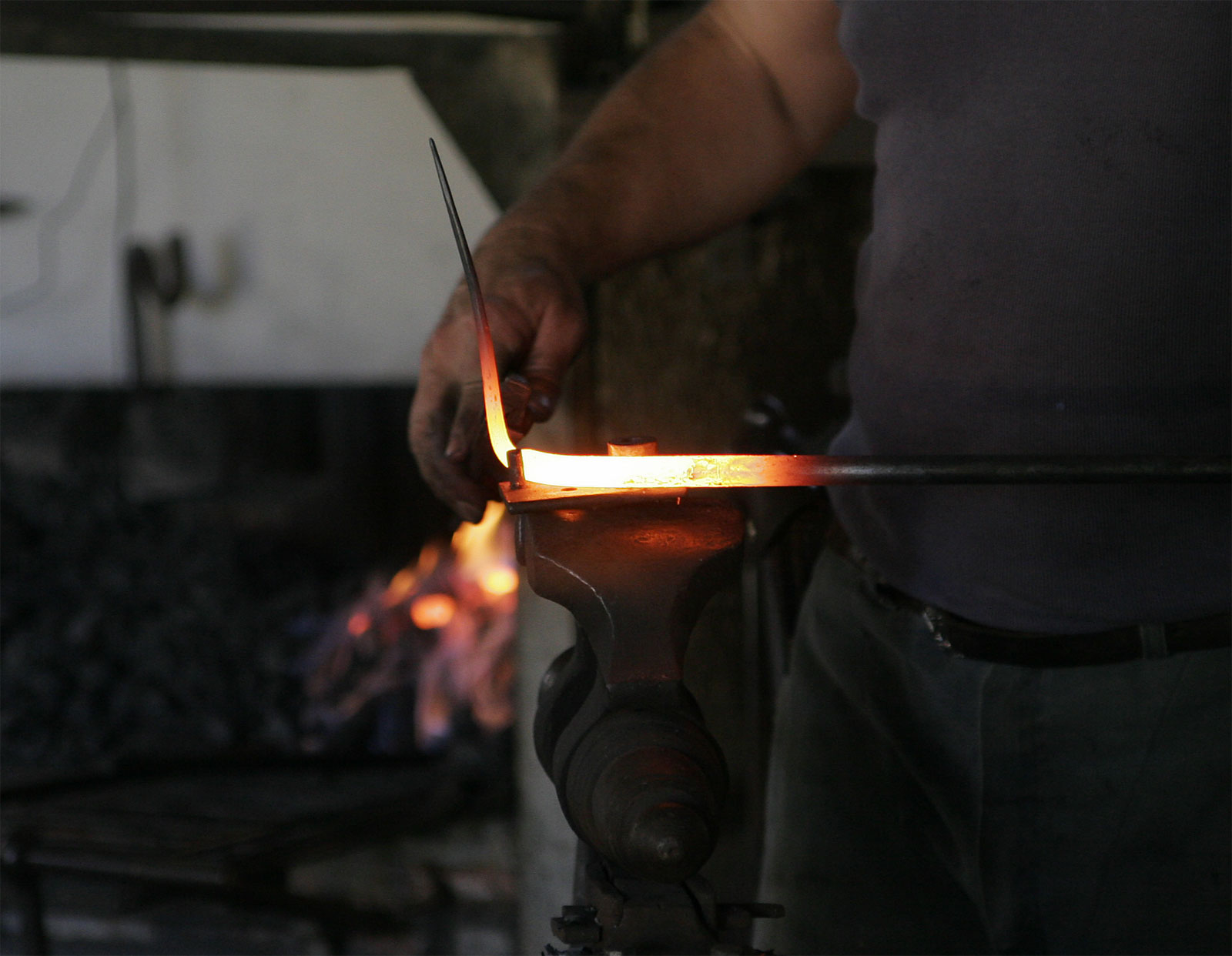
The physical plant of a frontier smithy was minimal by later standards: a forge (a hearth with forced-air supply from a bellows), an anvil, a post vise, hammers, tongs, and a water or slack tub for quenching. The forge was often the first permanent structure built on a smithy lot, sometimes preceding the smith's own house. Its priority in construction is a reliable indicator of how central the trade was to community function.
Work produced in a frontier smithy fell into three categories. First, agricultural ironwork: ploughshares, coulters, harrow teeth, ox yokes, chain links, and hooks. Second, construction hardware: hinges, latches, nails (which were hand-forged until cut nail manufacturing reached sufficient scale in the 1830s), and structural pins. Third, tool repair and manufacture: re-facing worn axe bits, drawing out new chisels from scrap stock, fitting iron bands onto wooden handles.
The Bellows and the Fire
The heart of any smithy was the forge fire, and the quality of that fire depended on the bellows. Early Canadian smithies used double-acting bellows — two chambers, each filling and expelling air alternately so that the air stream was continuous rather than pulsed. The bellows was typically mounted behind and above the forge hearth, connected to a tuyere (air nozzle) that directed the blast into the base of the coal or charcoal fire.

Fuel was a persistent concern. British smiths worked largely with coal; Canadian frontier smiths often had to work with charcoal produced from local wood. Charcoal fires burn hotter and cleaner than wood fires but require more fuel by volume. A smithy that could secure a supply of good blacksmith's coal — typically via waterway shipment once settlement was more established — had a significant operational advantage over one limited to charcoal.
Apprenticeship and Knowledge Transfer
Blacksmithing knowledge in pre-industrial Canada was transmitted almost entirely through apprenticeship. A boy typically entered a smithy at age 12 to 14, spending the first years at bellows-work and sweeping, then progressing to holding (steadying the work while the master struck), then to striking with a sledge hammer on the master's instruction, and finally — after several years — to independent work on straightforward jobs. Full mastery of the trade, including the capacity to weld iron and to judge metal temperature by colour, required years of accumulated sensory experience that could not be taught from a book.
The geographic spread of smithing skills across Upper Canada tracks closely with the movement of apprentice-trained smiths out of established shops in Kingston, York (now Toronto), and Niagara to found their own businesses in newly opened townships. Parish records and land registry documents from the 1820s to 1850s frequently record the arrival of a blacksmith as one of the first entries for a new concession.
Iron Supply and the Montreal Trade Network
Montreal functioned as the primary iron distribution hub for Upper Canada through most of the early 19th century. Merchants in the city imported bar iron and steel from Britain and re-exported it in smaller parcels upriver. The markups accumulated at each stage of transit meant that iron delivered to a smithy in the upper Ottawa Valley cost substantially more than the same iron at dockside in Montreal. This price gradient influenced what smiths could afford to stock and, by extension, what they could produce competitively for local customers.
The opening of the Rideau Canal in 1832 and the St. Lawrence canals through the 1840s changed this dynamic materially. Freight costs from Montreal to Kingston dropped significantly; iron became more affordable for smiths in the interior. By the 1850s, the combined effect of canal infrastructure and the beginning of domestic iron production in Ontario had begun to erode the supply constraints that had characterized the earlier period.
Decline and Persistence
The mechanization of agricultural implement manufacture — concentrated in firms like Massey in Newcastle, Ontario and Wisner in Brantford — progressively displaced the smithy's role in producing farm equipment. By the 1870s, a farmer could buy a factory-made ploughshare at a hardware store for less than a local smith could produce one. The smith's competitive ground shifted to repair work, horseshoeing, and specialty fabrication that factories could not yet address economically.
Horseshoeing remained a viable specialty through the first decades of the 20th century, sustaining rural smithies well past the point where other iron trades had mechanized. In communities without rail access — which in northern Ontario included most settlements until the early 20th century — the blacksmith continued to occupy the same essential role in the local economy that his predecessors had held in the 1810s. The last working blacksmiths in some remote Ontario communities were still active into the 1940s, doing the same repair-and-maintenance work the trade had always centred on.
Further Research
The most comprehensive treatment of Canadian smithing history remains Peter Moogk's chapter contributions to The Craft Tradition in Early Canada, available through the Library and Archives Canada digital collections. The Canadian Museum of History holds a significant collection of smithing equipment from the 18th and 19th centuries, with selected items accessible through their online catalogue.
For the technical side of pre-industrial ironworking, Alexander Weygers' The Complete Modern Blacksmith and the older Practical Blacksmithing compiled by M.T. Richardson (1889) both document hand processes that remained essentially unchanged from the colonial period through the early industrial era.